
QIANJIANG NATURE LAND
HOSPITALITY, CIVIC, COMMERCIAL, CULTURAL
Client
Hangzhou Municipal Government
Location Hangzhou, Zhejiang, China
Program Ecological landscape, public park, village regeneration, agriculture, public facilities
Area 3.4 km² / 840 acres (master plan area)
Status Competition, concept, first prize
Location Hangzhou, Zhejiang, China
Program Ecological landscape, public park, village regeneration, agriculture, public facilities
Area 3.4 km² / 840 acres (master plan area)
Status Competition, concept, first prize
Qianjiang Nature Land reimagines Chang’ansha as an inhabited ecological landscape where agriculture, wetlands, public life, and village culture coexist. Rather than treating nature as scenery surrounding development, the proposal makes landscape itself the framework for inhabitation.


The project is part of the design for the Chang’ansha area of Hangzhou’s Sanjianghui Green Heart Park. The wider proposal establishes an interconnected system of productive fields, ecological corridors, waterfront landscapes, villages, pedestrian routes, bridges, and public facilities. Within the village areas, green corridors extend into the existing settlement while new public buildings are introduced selectively. The strategy replaces only 18–20 percent of the existing village building area—approximately 2.7 hectares—while strengthening the relationship between settlement and landscape.
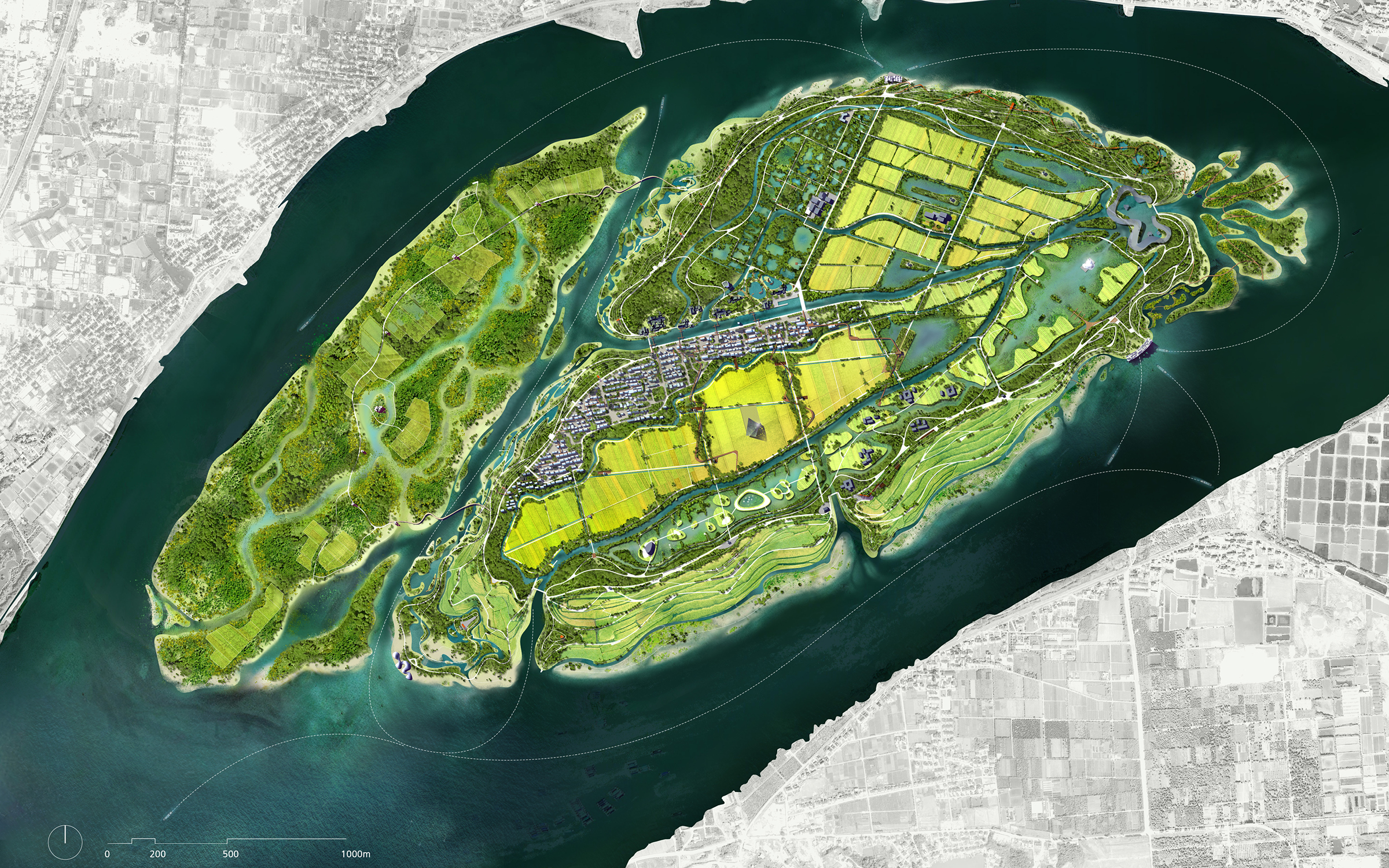

A multilayered pedestrian network connects waterfront promenades, landscape platforms, fields, gardens, and bridges. Pedestrian bridges link the north and south banks, while landscape platforms extend into the agricultural terrain. Together, these elements create a continuous public realm in which blue and green infrastructure, productive landscapes, and village life overlap.
Supporting infrastructure is conceived as part of this ecological network. Small service stations distributed throughout Chang’ansha operate like interconnected nodes, collecting rainwater and waste, supporting irrigation and energy systems, storing agricultural equipment, and providing places for residents and visitors to rest. Larger “Energy Houses” consolidate waste processing, resource and energy recovery, and rainwater purification.
Through these interventions, Qianjiang Nature Land proposes a contemporary relationship between settlement and ecology: one in which architecture is dispersed into the landscape and everyday life becomes inseparable from water, agriculture, biodiversity, and public space.
Supporting infrastructure is conceived as part of this ecological network. Small service stations distributed throughout Chang’ansha operate like interconnected nodes, collecting rainwater and waste, supporting irrigation and energy systems, storing agricultural equipment, and providing places for residents and visitors to rest. Larger “Energy Houses” consolidate waste processing, resource and energy recovery, and rainwater purification.
Through these interventions, Qianjiang Nature Land proposes a contemporary relationship between settlement and ecology: one in which architecture is dispersed into the landscape and everyday life becomes inseparable from water, agriculture, biodiversity, and public space.

Team
Andrew Heid, Jingjing Wu, Julianna Yang, Praveen Menon, Shiyin Zeng, Tracy Tang, Xianghui Kong, Yoki Luo
Andrew Heid, Jingjing Wu, Julianna Yang, Praveen Menon, Shiyin Zeng, Tracy Tang, Xianghui Kong, Yoki Luo
Collaborators
China Academy of Urban Planning and Design, ECOLAND, agenceTER
Distinctions
First prize
China Academy of Urban Planning and Design, ECOLAND, agenceTER
Distinctions
First prize