NATURAL HISTORY MUSEUM
CULTURAL, CIVIC
Client Engineering Design Management Center of Shenzhen Municipal Construction and Public Works Administration
Location Shenzhen, Guangdong Province, China
Program Museums, archives, auditoriums, cafes, research
Area 100,000 m² / 1,076,391 ft²
Status Competition, concept
Location Shenzhen, Guangdong Province, China
Program Museums, archives, auditoriums, cafes, research
Area 100,000 m² / 1,076,391 ft²
Status Competition, concept
A BRIDGE BETWEEN NATURE AND THE CITY
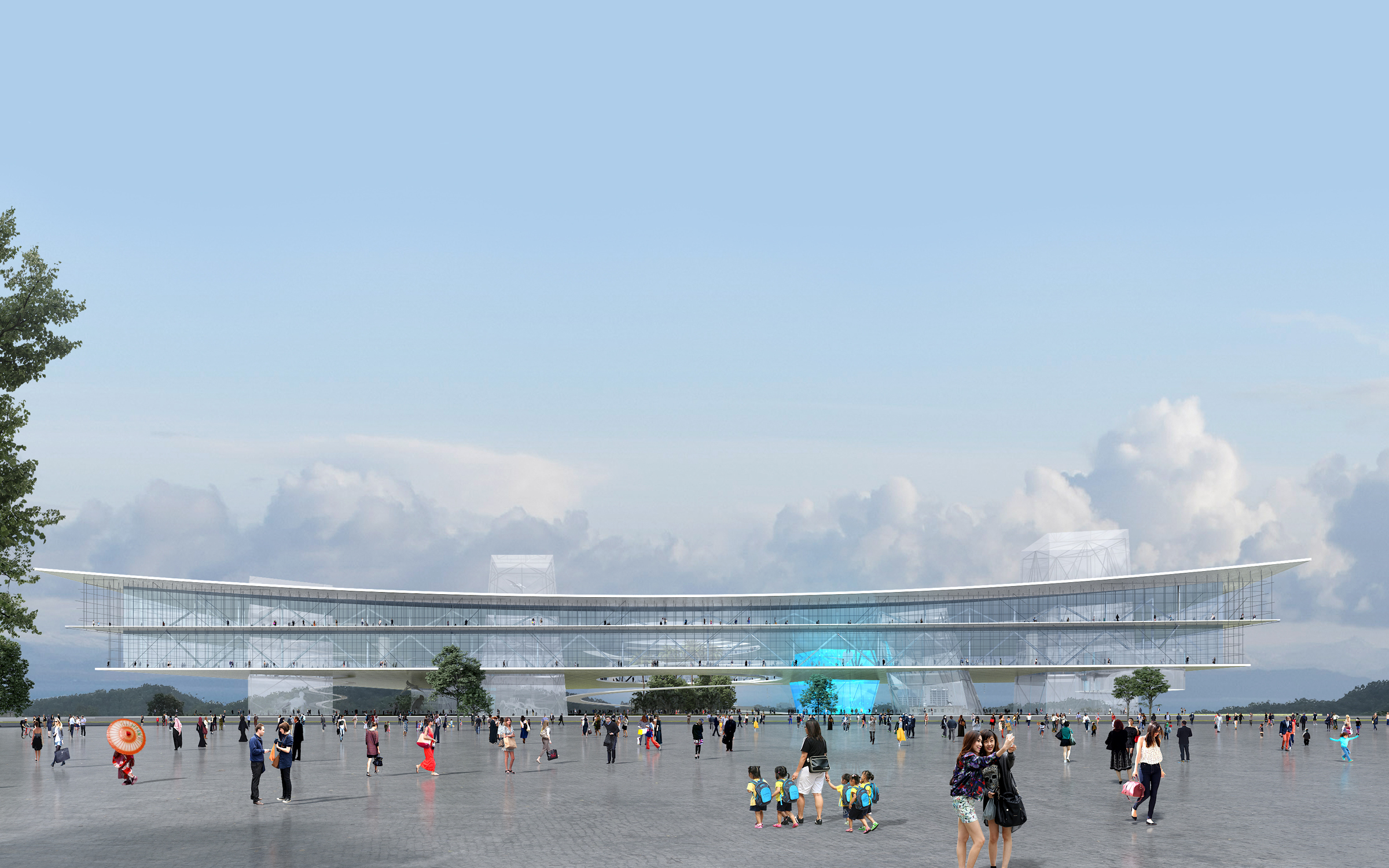
Natural History Museum transforms the museum into a three-dimensional landscape, where city, river, mountain, collection, research, and public life become one spatial order.
Located in Shenzhen, the project begins with a double condition. The museum must represent nature through exhibition, archive, research, and public education, but it must also belong to the physical natural environment around it: the river, the mountains, the city, the ground, the sky, and the movement of visitors through landscape.
Rather than treating the museum as a sealed container for natural history, the project creates a bridge between two dimensions of nature: nature as knowledge and nature as lived environment. The museum becomes a place where the representation of nature and the experience of nature are brought into relation.
The result is not simply a building about natural history. It is a landscape of encounter, where exhibition, research, public movement, water, mountain, and city are gathered into one inhabitable order.
A THREE-DIMENSIONAL MUSEUM LANDSCAPE
The project rethinks the museum as a spatial landscape rather than a single object. Exhibition, archive, auditorium, cafe, research, circulation, and public space are organized through a three-dimensional sequence of rooms, towers, terraces, paths, and open spaces.
Visitors move through the museum as they would move through a landscape. They ascend, pause, gather, look outward, enter darker rooms, emerge into light, pass between intimate and monumental spaces, and return to the larger city and terrain around them. Movement becomes part of the museum’s intellectual structure.
Natural history is therefore not presented only as information. It is experienced through sequence, scale, atmosphere, and orientation. The museum teaches through the body as well as through display.
CITY, RIVER, AND MOUNTAIN
The museum is conceived in synthesis with its surrounding city, river, and mountains. These conditions are not background. They are the primary spatial forces of the project.
The city gives the museum its public role. The river gives it movement, reflection, and ecological memory. The mountains give it orientation, horizon, and geological depth. Together, they establish the larger field within which the museum must operate.
Architecture gathers these forces into a new civic landscape. The project creates physical and visual connections between urban life and natural terrain, between collective public space and the deeper environmental systems that surround the city. The museum becomes a threshold where city and nature are no longer treated as opposites.
EXHIBITION TOWERS AS LANTERNS
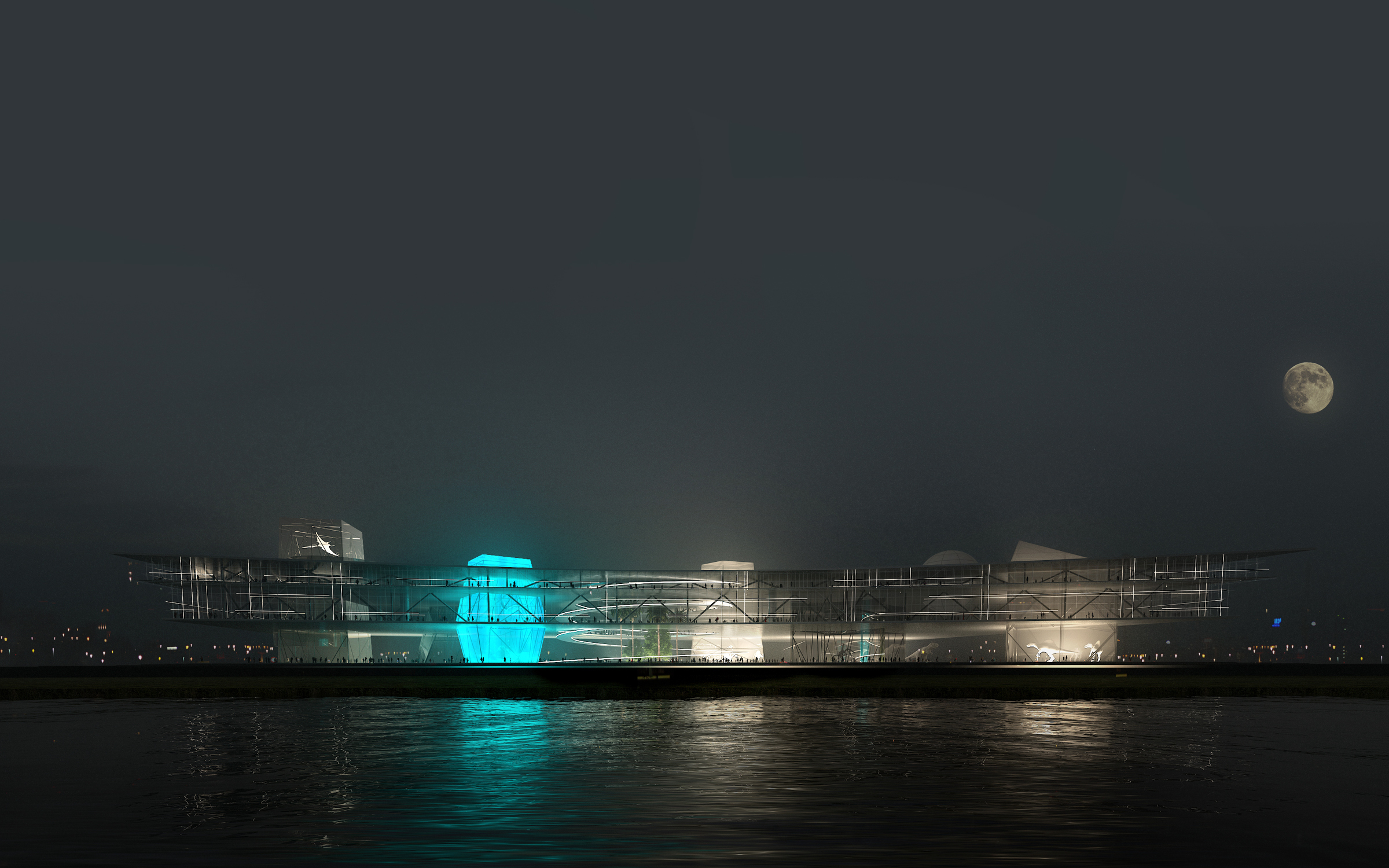
The museum’s exhibition towers rise within the larger landscape as vertical rooms of knowledge, orientation, and light. During the day, they structure the visitor’s movement through the museum. At night, they transform into glowing lanterns, giving the city a visible sign of public culture.
These towers are not isolated icons. They are part of a larger spatial system. They gather exhibitions, circulation, orientation, and light into vertical figures that connect ground, sky, city, and collection. Each tower becomes both a room and a marker, both interior world and civic presence.
The lantern image gives the project a public memory. It allows the museum to become visible in the life of the city without reducing it to spectacle. Light becomes a form of orientation.
INTIMATE AND MONUMENTAL
Natural history operates across radically different scales: fossil and mountain, specimen and ecosystem, archive and planet, human body and geological time. The museum gives spatial form to this range.
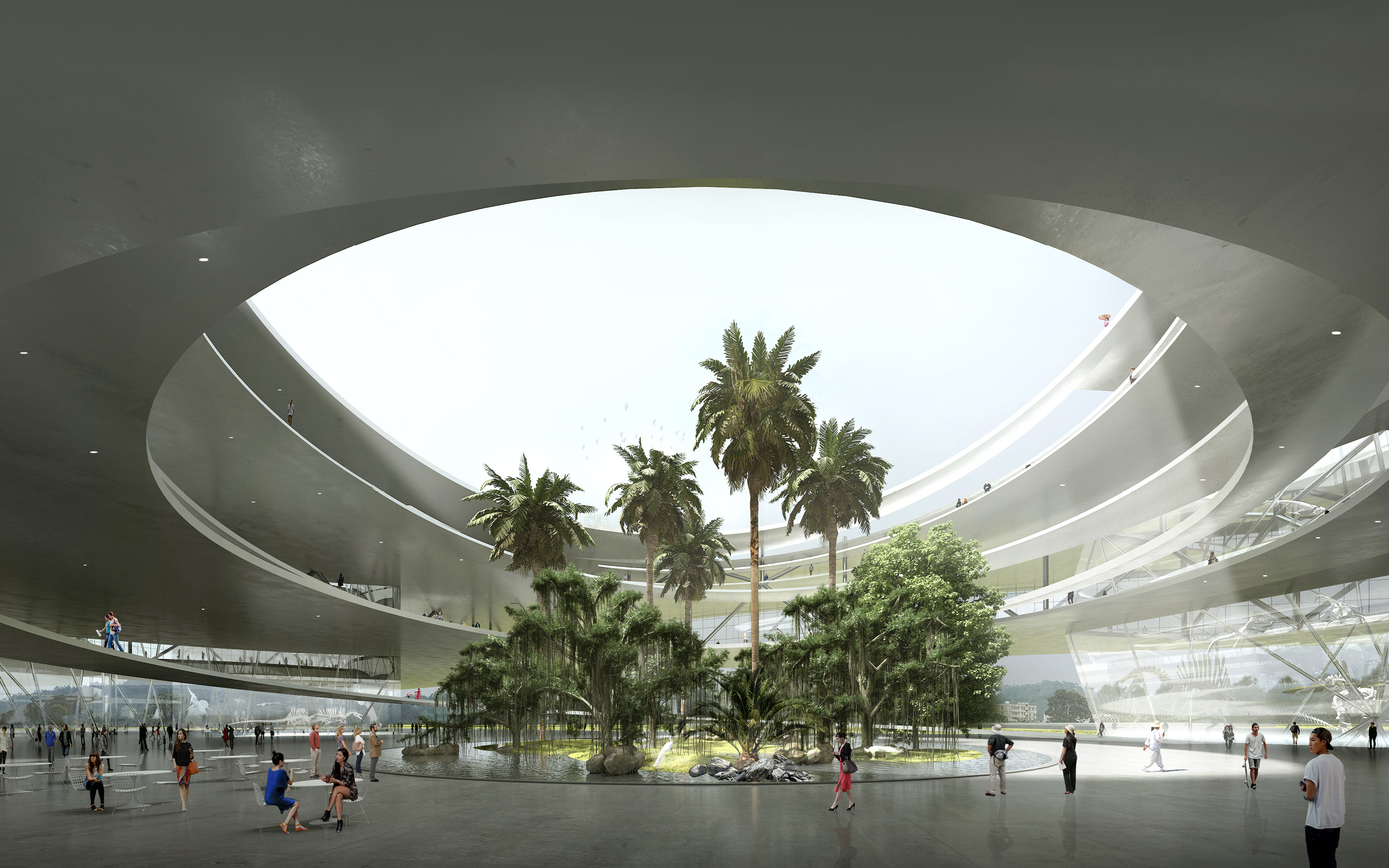
The project creates a sequence between intimate rooms and monumental spaces. Smaller exhibition and research areas allow close study, concentration, and encounter with objects. Larger public spaces open toward collective gathering, vertical movement, and the larger landscape beyond the building.
This relationship between the intimate and the monumental allows the museum to hold both knowledge and wonder. It supports careful observation while keeping visitors aware of the scale of the natural world beyond human measure.
PAST, FUTURE, AND PUBLIC MEMORY
A natural history museum is a building about time. It gathers the past through collections, fossils, archives, specimens, and research, but it also projects a future relationship between people, city, ecology, and the planet.
The project makes this temporal condition spatial. Visitors move between past and future, between evidence and imagination, between scientific knowledge and civic responsibility. The museum becomes a public framework for understanding the long histories that shape the present and the environmental futures that must be collectively formed.
This is why the museum is civic as well as cultural. It does not only preserve knowledge. It creates a shared place where society can understand its relationship to nature, time, and change.
A PUBLIC CLEARING FOR NATURAL HISTORY
Natural History Museum creates a civic clearing for the city: a place where public life gathers around the knowledge and experience of nature.
The project connects individual and collective experience. A visitor may encounter a specimen alone, move through an exhibition with others, ascend through a tower, look outward toward the river and mountains, gather in an auditorium, or pause in a cafe. These different forms of occupation are held within one spatial landscape.
The museum becomes a world within the world, ordered enough to orient visitors, open enough to remain connected to the larger environment, and generous enough to support public life at multiple scales.
GROUND, VOID, CANOPY, HORIZON, AND MOVEMENT
Natural History Museum is organized through ground, void, canopy, horizon, and movement. Ground connects the museum to the city and river. Void opens spaces of gathering, exhibition, and public orientation. Canopy shelters the civic landscape. Horizon connects the museum to mountain, sky, and geological time. Movement turns knowledge into experience.
Through this order, the project transforms the museum typology from a container of objects into an inhabitable landscape of relations. Nature is not only represented inside the museum. It becomes the spatial structure through which the museum is experienced.
The result is a new public landscape for natural history: a bridge between city and mountain, knowledge and wonder, past and future, human life and the larger natural world.
Collaborators
Clément Blanchet Architecture, dUCKS Sceno, Laurent Menabe Images
Team
Andrew Heid, Junwei Li, Zhangzheng Yang
Clément Blanchet Architecture, dUCKS Sceno, Laurent Menabe Images
Team
Andrew Heid, Junwei Li, Zhangzheng Yang