
ALLEGHENY MOUNTAIN HOUSE
RESIDENTIAL
Client Confidential
Location Deep Creek Lake, MD
Program Private residence
Area 400m²
Type Commission
Status Ongoin
Location Deep Creek Lake, MD
Program Private residence
Area 400m²
Type Commission
Status Ongoin
A PLINTH BETWEEN MOUNTAIN AND LAKE
Allegheny Mountain House transforms a steep lake-edge site into an inhabited plinth, where ground, roof, courtyard, and horizon become one continuous order.
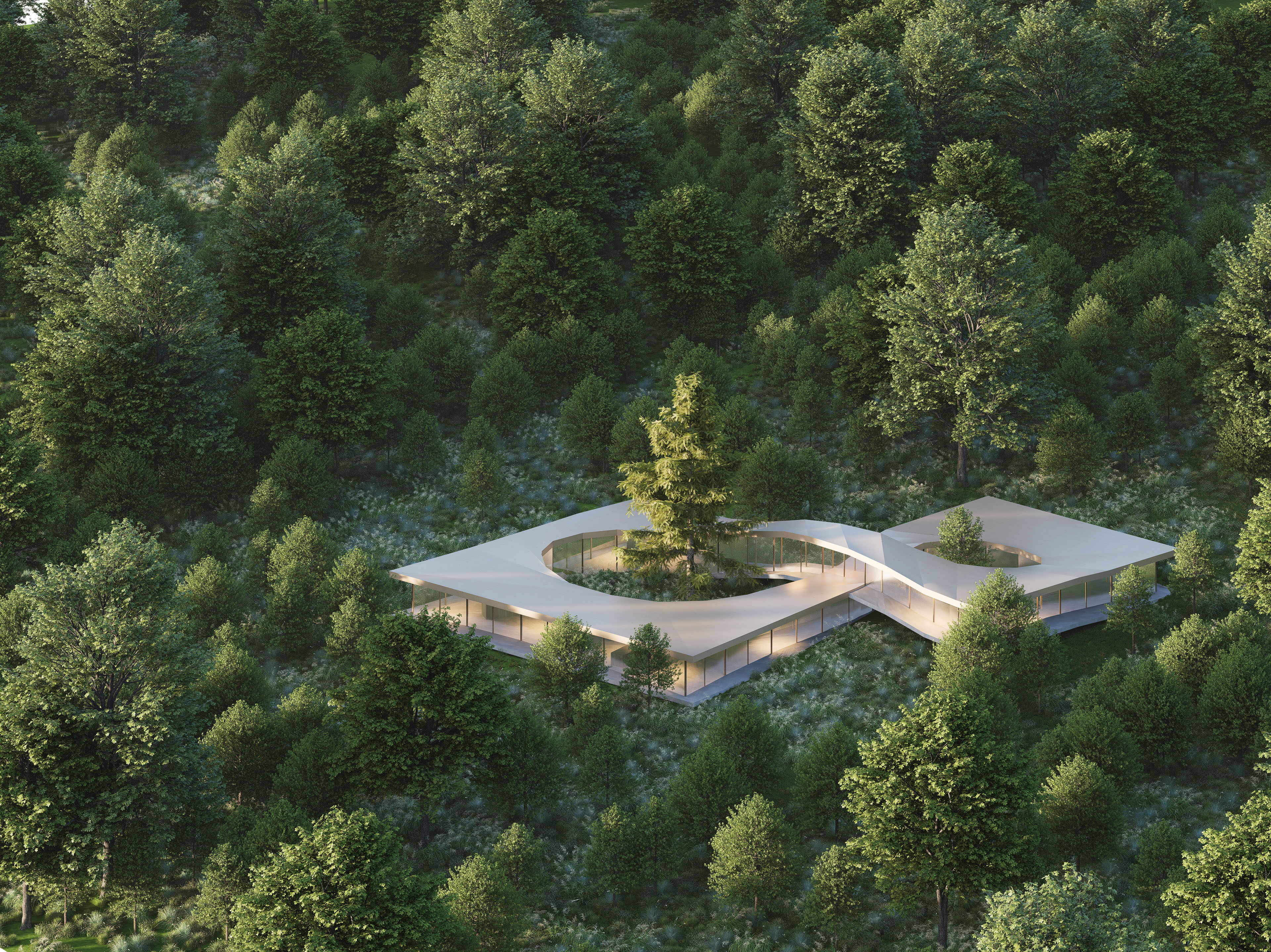
Set above Deep Creek Lake in Maryland, the project begins with a mountain landscape shaped by slope, water, forest, and horizon. Rather than placing a house on the edge as an object facing the view, the architecture cuts into the ground to create a single plinth. This plinth anchors the house to the mountain while allowing the structure to hover toward the lake.
The project is conceived as an inhabited landscape compressed between floor and roof. A continuous loop folds, turns, and warps across the site, creating a house that is both grounded and elevated, both protected and open. Daily life unfolds within this loop, moving between interior rooms, covered terraces, courtyards, and views toward the lake.
The result is not simply a residence overlooking water. It is a way of living between mountain, lake, ground, and sky.
A CONTINUOUS LOOP OF DWELLING
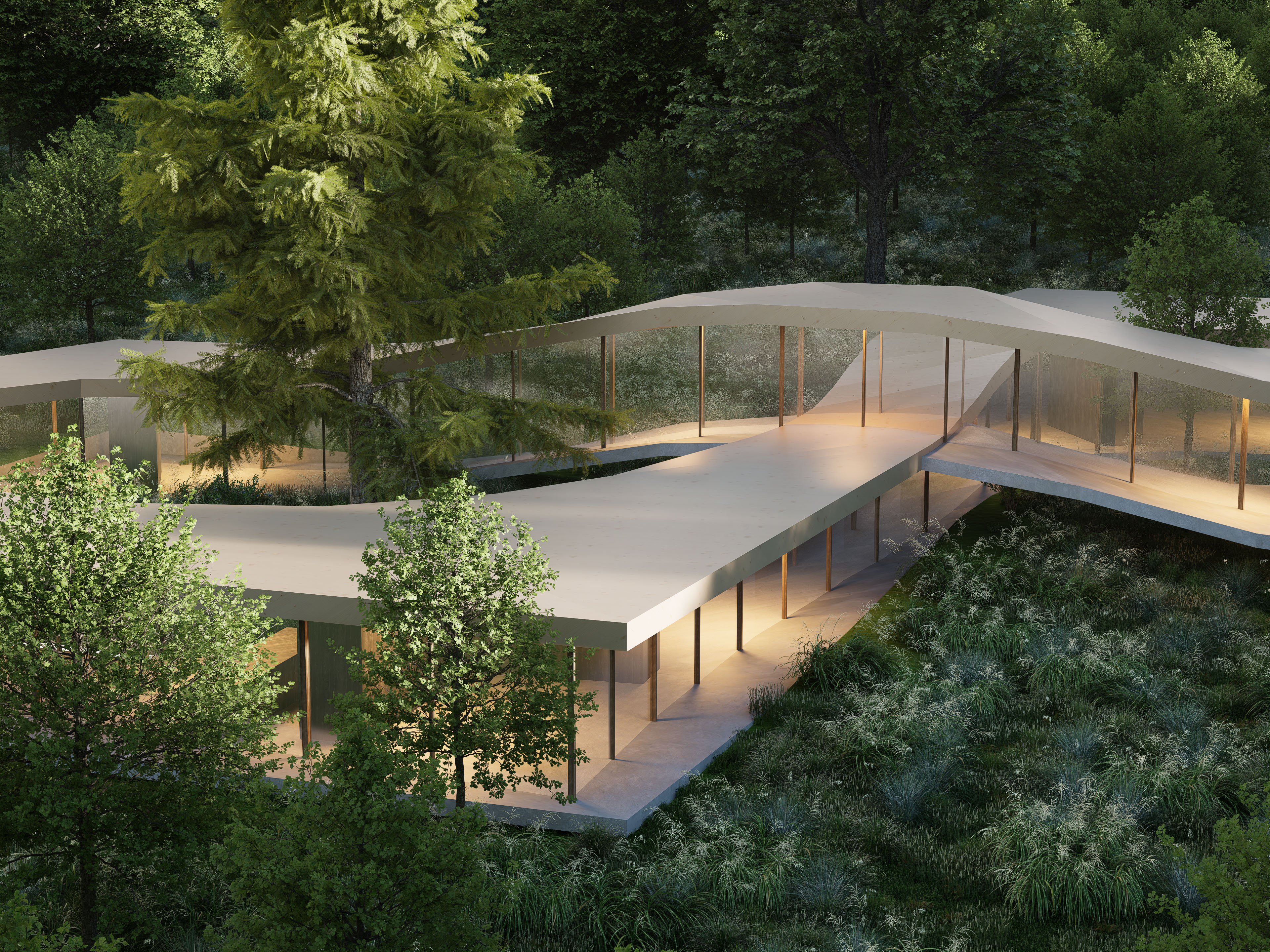
The house is organized as a single continuous loop. Rather than separating rooms into isolated volumes, the project gathers domestic life into a flowing spatial sequence. Movement becomes the structure of the house: entering, turning, looking, gathering, withdrawing, crossing, and returning.
Like a double helix, the floor and roof planes shift horizontally and vertically to produce changing relations between interior and exterior. The house remains one continuous order, yet within that order, rooms, courts, terraces, and thresholds are differentiated by light, height, view, enclosure, and exposure.
This loop gives the house both unity and variety. It allows daily life to move through a sequence of conditions rather than remain fixed in a single room or view. The architecture is understood through occupation: by walking around the plinth, passing through the courts, moving beneath the roof, and returning again to the lake horizon.
GROUND AS STRUCTURE
The site is defined by slope. Allegheny Mountain House does not flatten this condition. It uses ground as the primary architectural material. The plinth cuts into the mountain, minimizing excavation while giving the house a clear relation to terrain.
Ground becomes more than support. It becomes plan, threshold, privacy, and orientation. The cut of the plinth creates a protected base from which the house can extend toward the lake. The building belongs to the slope not by disappearing into it, but by transforming the slope into inhabitable order.
This relation to ground allows the house to hold two conditions at once. Toward the mountain, it is anchored and protected. Toward the lake, it opens and hovers. The project turns the tension between weight and lightness into the central spatial act of the house.

COURTYARDS WITHIN THE LANDSCAPE
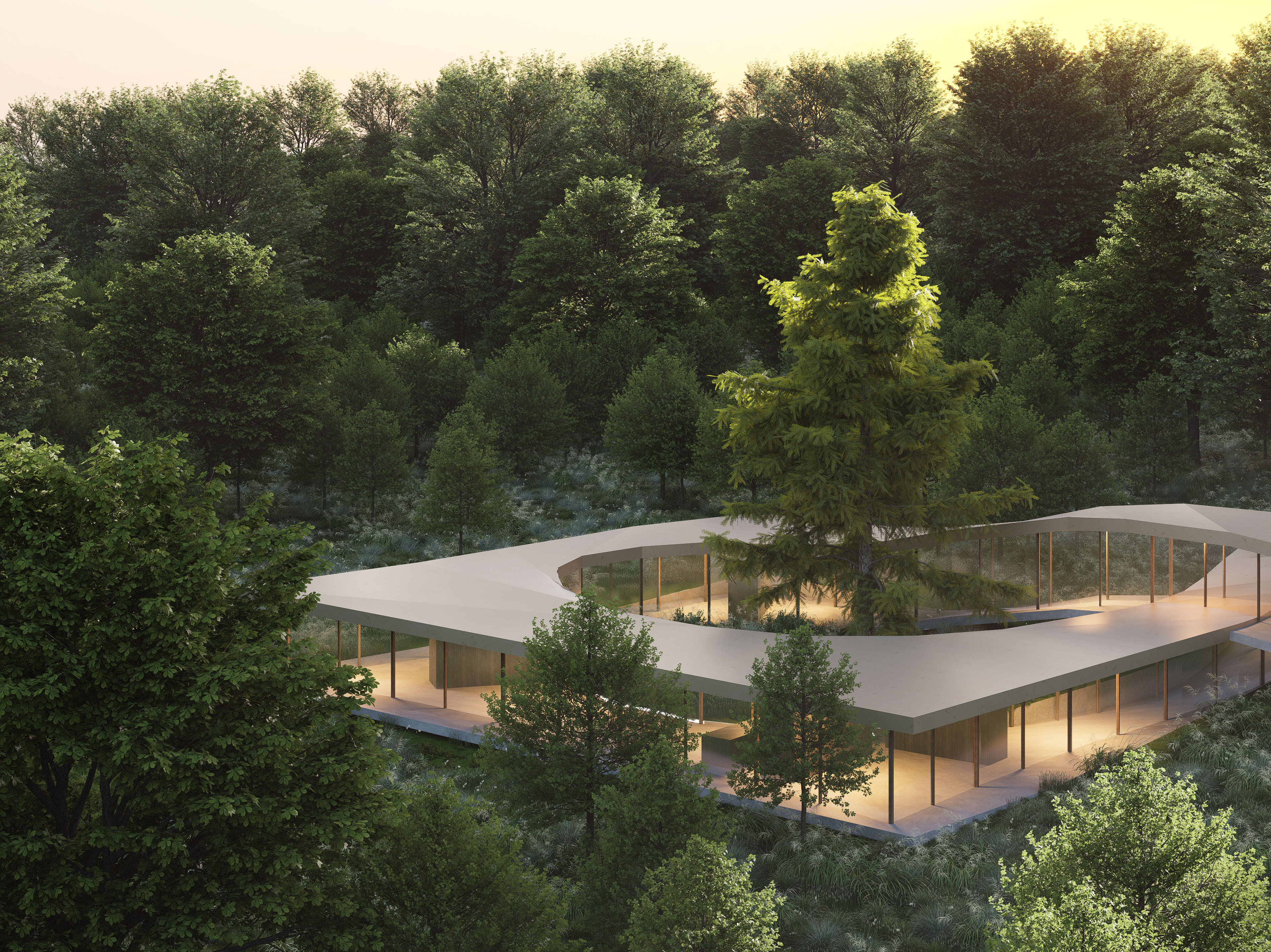
Two exterior courtyards are formed within the continuous loop. These courtyards bring light, air, vegetation, and sky into the depth of the house, allowing the horizontal landscape to enter the interior order.
The courtyard is not treated as an amenity or decorative garden. It is an instrument of orientation. It gives the house interior centers, moments of pause, and changing relations to weather and time. The courtyards allow the house to open inward while also extending outward toward the lake.
Through these voids, the project becomes more than a perimeter around a view. It becomes a world of rooms, courts, terraces, and thresholds. The lake remains present, but it is not the only organizing force. Sky, ground, vegetation, privacy, and movement become equally important to the life of the house.
A CANOPY AT THE LAKE EDGE
The roof extends beyond the glass enclosure to create a continuous covered terrace. This setback between glass and roof edge allows the body to move around the house beneath shelter while remaining connected to weather, landscape, and horizon.
The canopy gives climate architectural form. It protects from sun and rain, deepens the threshold between interior and exterior, and allows the house to remain open without becoming exposed. Beneath the roof, the terrace becomes a sheltered edge between domestic life and the larger landscape.
The roof does not simply cover the house. It gathers it. It ties the loop, courtyards, terraces, and rooms into a single spatial order. It gives the project a calm horizontal datum against the shifting ground and open lake.
HORIZON, WATER, AND RETURN
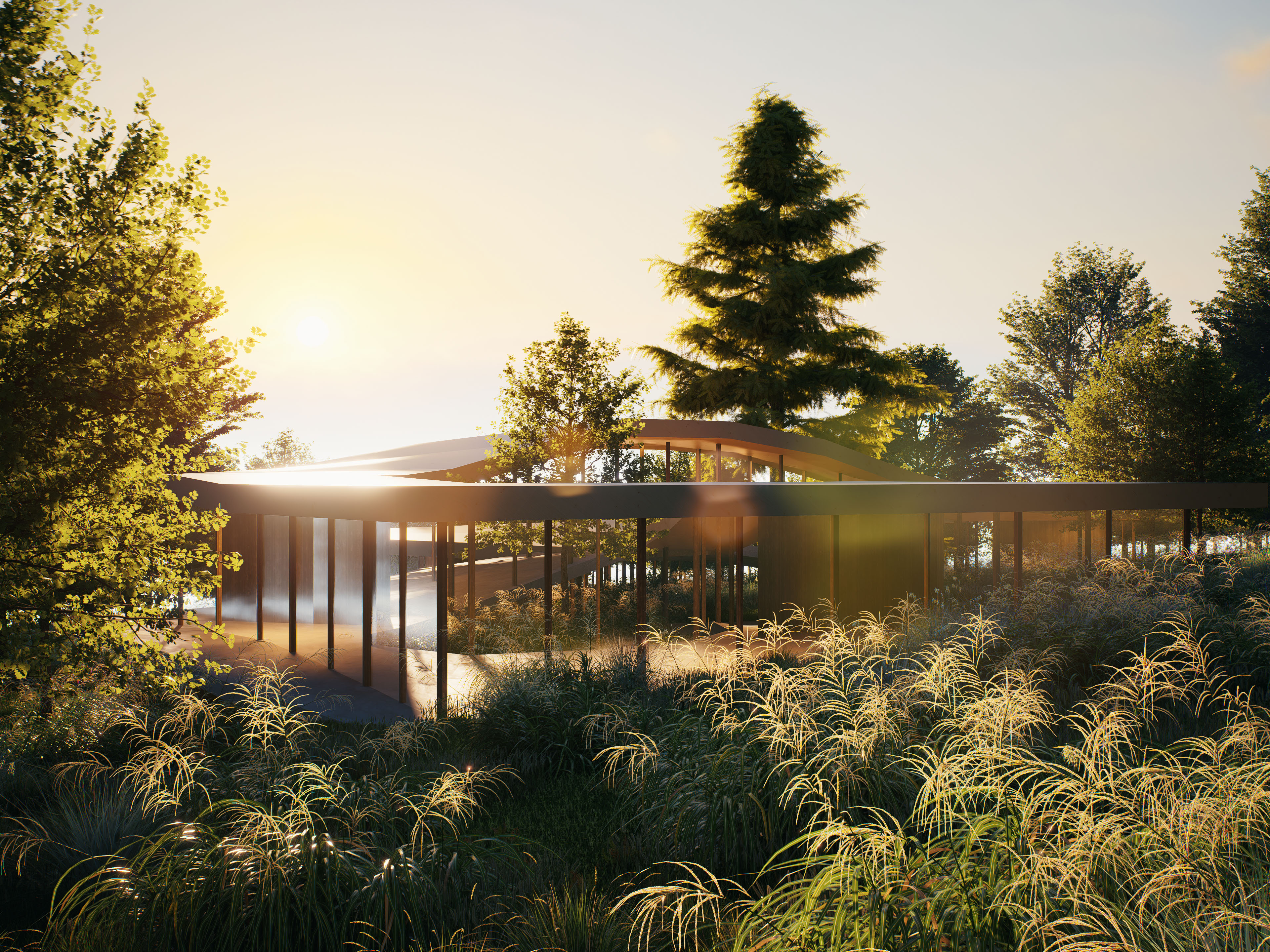
Allegheny Mountain House is organized by the relationship between mountain ground and lake horizon. Water gives the house distance and orientation. Ground gives it weight and belonging. The roof gives it shelter. The loop gives it movement.
The house does not treat the lake as scenery alone. The lake becomes a spatial presence that organizes how rooms open, how terraces extend, how movement returns, and how daily life is oriented toward a larger world. Views are not simply framed; they are absorbed into the sequence of dwelling.
Through ground, void, canopy, horizon, and movement, Allegheny Mountain House transforms a lake-edge site into a continuous domestic landscape. It creates a place where life can gather between earth, water, mountain, and sky.
Team
Andrew Heid, Nicole Mattos, Marta Rodrigues, Naiding Yao, Zijing Wang
Andrew Heid, Nicole Mattos, Marta Rodrigues, Naiding Yao, Zijing Wang