COUGAR RIDGE HOUSE
RESIDENTIAL
Client Private
Location Santa Ynez Mountains, Santa Barabara County, California, US
Program Single family residence
Area 485 m² / 5,217 ft²
Status Commission, on-going
Location Santa Ynez Mountains, Santa Barabara County, California, US
Program Single family residence
Area 485 m² / 5,217 ft²
Status Commission, on-going
A RIDGE MADE INHABITABLE
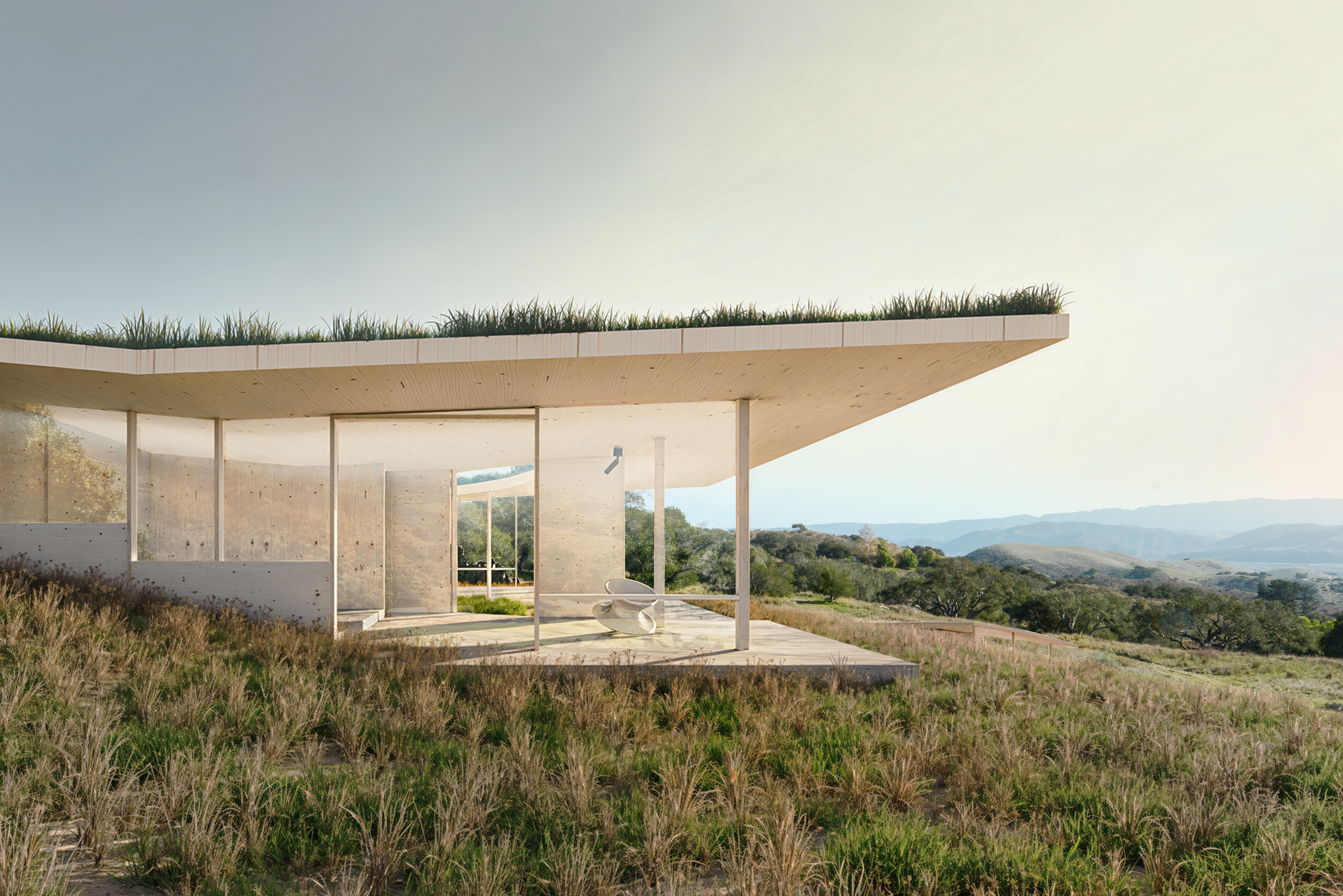
Cougar Ridge House transforms a steep Santa Ynez ridge into a dispersed domestic landscape, where oak groves, slope, canopy, courtyard, horizon, and movement become one spatial order for dwelling.
Set on a 20-acre site in the Santa Ynez Mountains, the project begins with a dramatic topographic condition. The land falls toward uninterrupted views to the south, east, and west, while clusters of native oak trees create pockets of shade, enclosure, privacy, and orientation across the ridge.
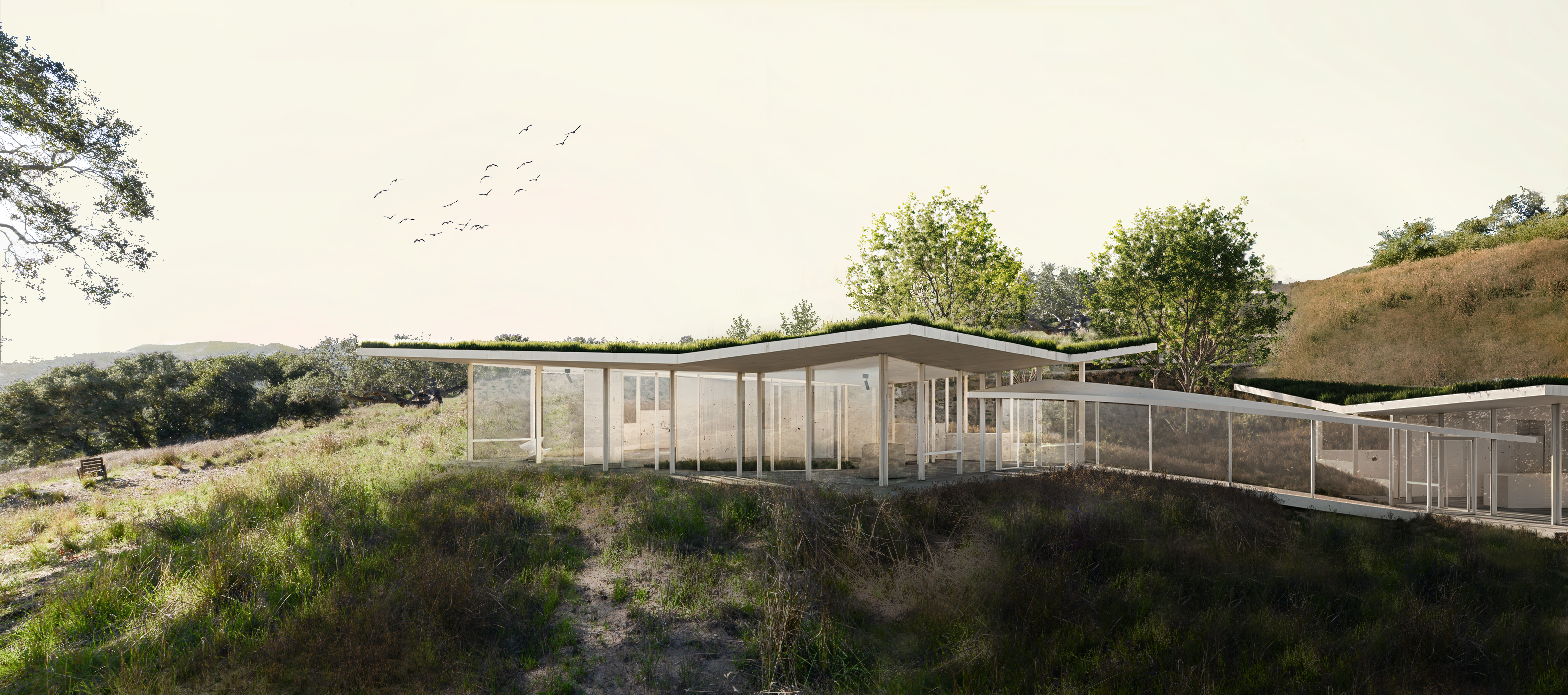
Rather than placing one large house on the site, Cougar Ridge House disperses domestic life across a series of pavilions connected by an outdoor covered walkway. The house becomes a sequence through the land: main house, guest house, pool cabana, gazebos, courtyards, terraces, oak groves, and long horizons held within one continuous architectural order.
The result is not simply a residence with panoramic views. It is a ridge made inhabitable: a house where daily life unfolds through movement between ground, trees, shelter, courtyard, and distance.
A HOUSE DRAWN FROM TOPOGRAPHY
The site is shaped by slope. Ground falls, turns, opens, and gathers, producing different relationships to view, privacy, exposure, and shelter.
Cougar Ridge House works with this terrain rather than flattening it. The pavilions are positioned to register the changing elevation of the ridge, while the covered walkway follows the natural contours of the fields and ridgelines. Movement across the house becomes a way of reading the land.
The project is therefore not organized as a single object on a platform. It is drawn from the site’s existing relationships of slope, oak, field, ridge, and horizon. Ground becomes the structure of the plan.
OAK GROVES AS SPATIAL ORDER
The native oak groves are not treated as landscape background. They are part of the architecture’s spatial order.
Their trunks, canopies, shadows, and clearings determine how the pavilions are placed, how the walkway moves, how privacy is created, and how views are framed. The oaks create rooms of shade within the larger openness of the ridge. They offer shelter without enclosure and help mediate between the intimacy of domestic life and the vastness of the Santa Ynez Valley.
The house does not simply preserve the trees as objects. It uses the spatial intelligence of the oak groves — shade, branching, filtered light, seasonal atmosphere, and clustered enclosure — to organize dwelling.

THE COVERED WALKWAY
The covered walkway is the social and spatial thread of the project.
It connects the main house, guest house, pool cabana, and covered gazebos while weaving between the native oak groves. It frames views of the distant landscape and follows the contours of the property, allowing movement to become part of the experience of the ridge.
The walkway is not only circulation. It is the project’s main sequence: a sheltered path between privacy and gathering, house and landscape, shade and exposure, oak canopy and valley horizon.
Through the walkway, the residence becomes a compound rather than a single house. Each pavilion retains its own relationship to ground, view, and use, while the covered path gathers them into one inhabitable landscape.
THREE GLASS COURTYARDS
The main house is positioned above the central open field, framed by the surrounding covered walkway. Conceived as two separate pavilions connected by an enclosed glass passage, the house is organized around three internal glass courtyards.
These courtyards bring sky, light, vegetation, and air into the depth of the plan. They prevent the house from becoming only outward-facing toward the valley. Instead, the house holds both inward and outward worlds: the intimate sky of the courtyard and the distant horizon of the mountains.
The courtyards give the main house its inner order. They gather daily life around light and air while maintaining privacy, orientation, and connection across the pavilions.
MATRIX PLAN
A series of cruciform and T-shaped storage cores organize the interior through the office’s matrix plan.
These cores hold storage, service, and support spaces while shaping perimeter circulation and opening the communal rooms toward the Santa Ynez Mountain vistas. They do not simply divide space. They give the openness of the house structure and measure.
The matrix plan allows the house to remain open to view without becoming formless. Service becomes order. Circulation becomes sequence. Storage becomes spatial thickness. The communal life of the house is held between courtyards, cores, glass, and horizon.
EXCAVATED HILLSIDE
To the north, the upper pavilions are excavated into the hillside. This excavation creates privacy, thermal stability, and a direct relationship to the below-ground wine cave and garage.
The hillside becomes more than a backdrop. It becomes wall, threshold, insulation, and anchor. Earth holds the more private parts of the house while the glass edges open southward, eastward, and westward toward the valley.
This section creates a clear gradient: protected rooms within the slope, open rooms toward the horizon, and courtyards bringing sky into the space between. The house belongs to the ridge because it is partly made from the ridge.
MASS TIMBER ROOF UMBRELLA CANOPIES
The roof plates are conceived as mass timber umbrella canopies, echoing the extended branching structure of the surrounding native oaks.
Constructed of cross-laminated timber, the canopies extend in two-way cantilevers and slope upward toward the views. They create shelter, shade, structure, and orientation while allowing the experience of the house to remain open to landscape, weather, and horizon.
The canopies are not only roofs. They are the architectural counterpart to the oak canopy. They gather domestic life beneath a constructed field of shelter, allowing rooms, terraces, walkways, and views to belong to one continuous order.
Roof becomes canopy. Canopy becomes climate. Climate becomes architecture.
HORIZON AS ORIENTATION
Cougar Ridge House is organized by horizon. The panoramic views of the Santa Ynez Valley are not treated as scenery beyond the house. They become the orientation of daily life.
Each pavilion establishes a distinct relation to distance. Some rooms open broadly toward the valley. Others are held closer to the hillside or oak groves. The house moves between enclosure and exposure, shade and view, inward court and outward horizon.
Through this order, the ridge is not simply observed from the house. It is inhabited through a sequence of changing relationships to field, tree, slope, sky, and distance.
A DOMESTIC LANDSCAPE BETWEEN OAK AND SKY
Cougar Ridge House is organized through ground, void, canopy, horizon, and movement. Ground gives the ridge its section. Void enters through the glass courtyards and open fields between pavilions. Canopy shelters rooms, paths, and terraces through both oak trees and mass timber roofs. Horizon orients the house toward the Santa Ynez Valley. Movement connects the dispersed pavilions into one continuous domestic sequence.
Through this order, the project transforms a steep ridge site into an inhabitable landscape. Oak becomes room. Slope becomes section. Courtyard becomes inner sky. Roof becomes canopy. Walkway becomes path. Horizon becomes orientation.
The result is architecture for life between earth and sky: a house where ridge, oak, courtyard, canopy, view, and daily life are gathered into one spatial order.
Team
Noah Fritsch, Andrew Heid, Nanjia Jiang, Xianghui Kong, Chengliang Li, Tsung-Han Lin, Yuedong Lin, Yoki Luo, Praveen Menon, Jennifer Newman, Jianqing Shou, Tracy Tang, Jingjing Wu, Julianna Yang, Shiyin Zeng, Xinglu Zhu, Jaewon Kim, Weizi Song
Collaborators
CAM Land Use, Flower Associates, PleinAire Design Group
Noah Fritsch, Andrew Heid, Nanjia Jiang, Xianghui Kong, Chengliang Li, Tsung-Han Lin, Yuedong Lin, Yoki Luo, Praveen Menon, Jennifer Newman, Jianqing Shou, Tracy Tang, Jingjing Wu, Julianna Yang, Shiyin Zeng, Xinglu Zhu, Jaewon Kim, Weizi Song
Collaborators
CAM Land Use, Flower Associates, PleinAire Design Group